
POLYGONAL DEFINITION & CLASSIFICATION
WHAT IS POLYGONAL MASONRY?
Polygonal masonry is a stone-building technique in which blocks are deliberately shaped (roughly or precisely) into irregular polygonal forms and fitted together without mortar. The complex construction relies on multiangular joints rather than horizontal courses to provide stability. Polygonal masonry is known for its durability and earthquake resistance.
Common terms to describe polygonal masonry include Cyclopean, Pelasgian, megalithic, dry-stone masonry, or irregular ashlar masonry.
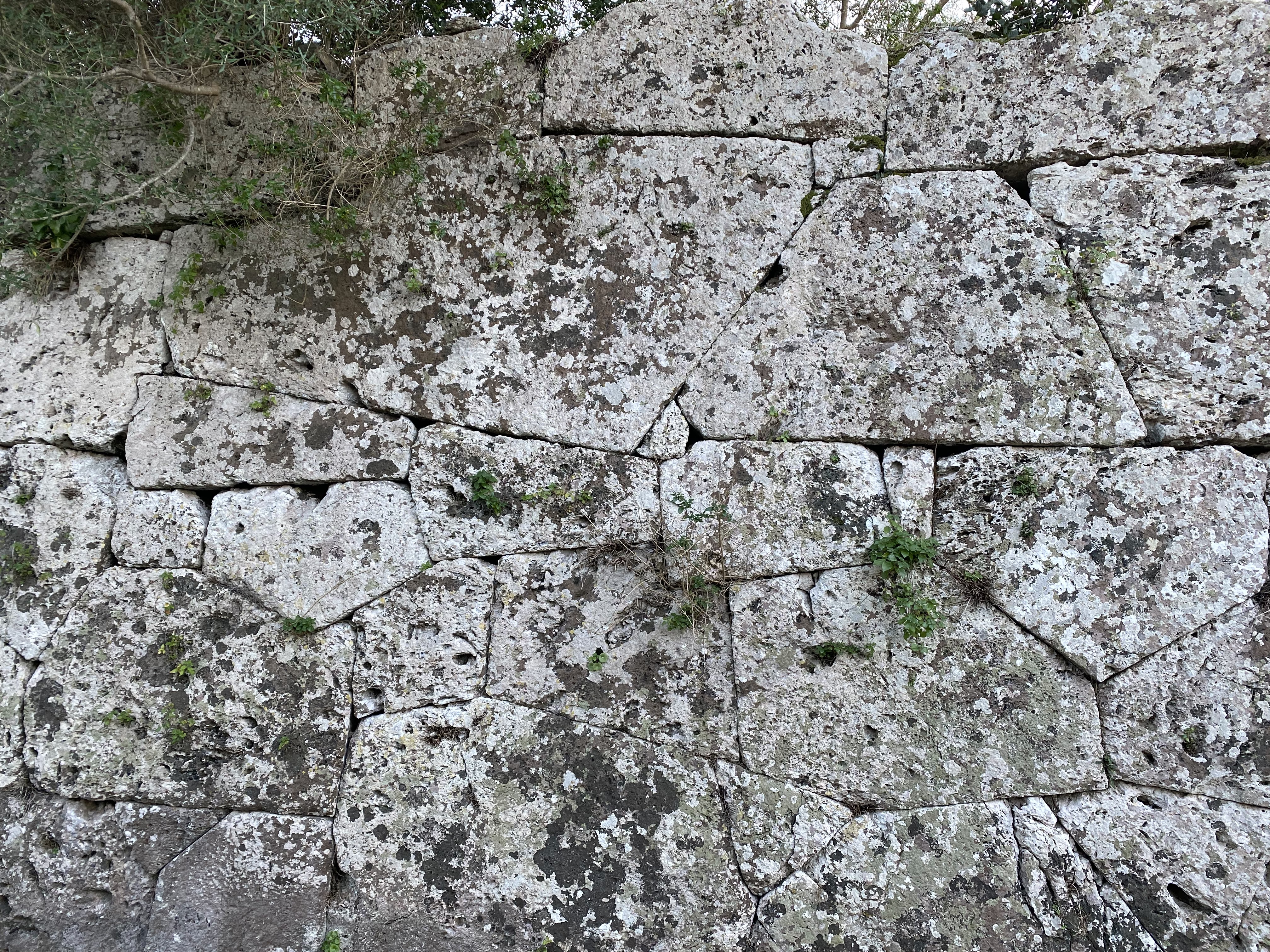
One particular term often used to describe such stonework is opus siliceum and is supposedly derived from Vitruvius’ reknowned work on Roman architectural and engineering practices, De Architectura. Despite making references to siliceus stonework (hardstones like limestone), Vitruvius does not associate this type of stone with any specific “opus” technique or more importantly polygonal masonry. He does, however, specifically mention four other stonework methods used by the Romans throughout their history. These include:
Opus Caementicium – the foundational Roman construction method consisting of a mix of aggregate such as rubble, volcanic tuff, or bricks and mortar (often made with volcanic pozzolana ash for hydraulic strength). It was used to build durable walls, vaults, and domes.
Opus Quadratum – a technique using large, rectangular blocks of stone set in parallel courses, often without mortar.
Opus Incertum – an early Roman technique where irregular, uncut stones are placed randomly into a core of opus caementicium.
Opus Reticulatum – a method popular in the 1st century BC using diamond-shaped tuff blocks placed in a net-like pattern, covering a concrete core.
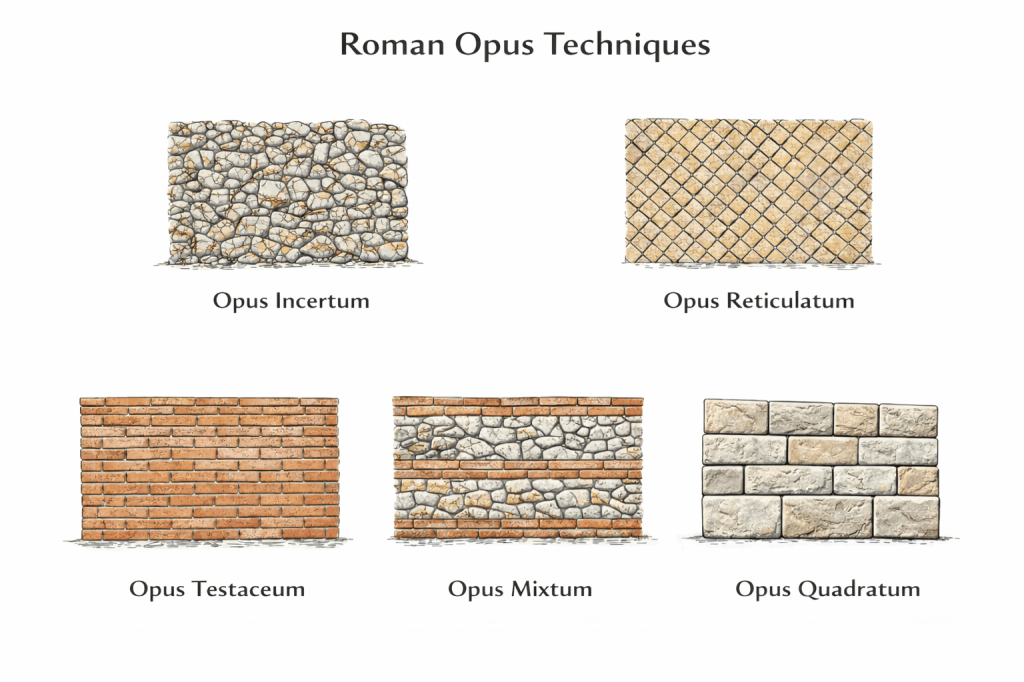
Vitruvius also describes two additional techniques within the quadratum typology: Opus Isodomum and Opus Pseudoisodomum. Opus Isodomum and Opus Pseudoisodomum are ancient Greek and Roman stone masonry techniques characterized by precisely cut rectangular stone blocks, yet they differ in uniformity. According to Vitruvius, Isodomum uses consistent block heights throughout each horizontal course while pseudoisodomum utilizes varying, often alternating, course heights. Neither style appropriately describes polygonal masonry.
The absence of references to polygonal masonry in Vitruvius is significant for several reasons. First, De Architectura presents itself as a comprehensive account of Roman building practices, encompassing both earlier traditions and those current in Vitruvius’ own time. The omission of polygonal masonry—despite its clear and widespread presence throughout Italy at the time of writing—suggests that the Romans did not credit themselves with this form of construction, or at the very least regarded it as lying outside the established Roman architectural tradition.
Second, this omission calls into question the modern use of the term opus siliceum. The designation does not appear in Vitruvius, and its frequent use in modern scholarship rests on an assumed Roman attribution that is not supported by the ancient literary record. Continued reliance on this terminology risks reinforcing a connection that may be retrospective rather than historical. Caution in its use is warranted until corroborating evidence emerges.
Moreover, Rome itself—the political and cultural center of the empire—contains no surviving examples of polygonal masonry, further weakening the case for its inclusion within a distinctly Roman building tradition. Finally, Vitruvius’ silence aligns with the testimony of other Roman-era antiquarians, who consistently allude to an even earlier phase of monumental stone construction, one that predates Roman expansion. The Italic peoples encountered by Rome appear, in many cases, to have settled landscapes already marked by an ancient and inherited tradition of stonework.
Here are a few excerpts from Roman antiquarians which corroborate a more ancient and mysterious stonework legacy:
Varro
De Lingua Latina 5.143
Silex dictus a silendo, quod non cito atteratur; ex eo facta sunt antiquissima moenia.
“Silex is so called from its resistance to wear; from it were made the most ancient walls.”
Livy
Ab Urbe Condita 1.33.8
Saxa ingentia mole sua posita, magis quam arte.
“Stones of enormous size, placed by their sheer weight rather than by refined technique.”
Dionysius of Halicarnassus
Roman Antiquities 1.68.1–2
λίθοι μεγάλου μεγέθους… οὐ κατὰ τέχνην Ἑλληνικήν, ἀλλὰ παλαιᾶς τινος καὶ βαρβαρικῆς ἐργασίας
“Stones of very great size… not according to Greek technique, but according to a certain ancient and non-Greek method of construction.”
Pliny the Elder
Naturalis Historia 36.171
Iam pridem silent artifices, qui saxis tantis moenia struxerunt.
“Long since silent are the craftsmen who built walls with stones of such size.”
Pliny the Elder
Naturalis Historia 36.27
Silex ad sacra et moenia antiquissima adhibitus.
“Silex was used for sacred rites and for the most ancient walls.”
Roman antiquarian authors repeatedly describe the earliest fortifications in Italy as constructions of massive hard stone, achieved by methods no longer practiced or fully understood in their own time. While these authors do not describe masonry geometry or technique in detail, their emphasis on antiquity, material scale, and the disappearance of the builders suggests that such works lay outside the conceptual and technical framework of Roman architectural knowledge. Even more compelling, the surviving archaeological record indicates that many of these early fortifications were built in polygonal or megalithic masonry, allowing a cautious correlation between the literary testimony and the physical remains.
HOW ARE POLYGONAL WALLS CLASSIFIED?
When it comes to properly classifying polygonal masonry, one can often run into a bit of trouble. Each region, especially in the Mediterranean, has its own definitions and descriptions. Similarly, on the other side of the world in Peru, there are unique approaches to describing polygonal masonry styles.
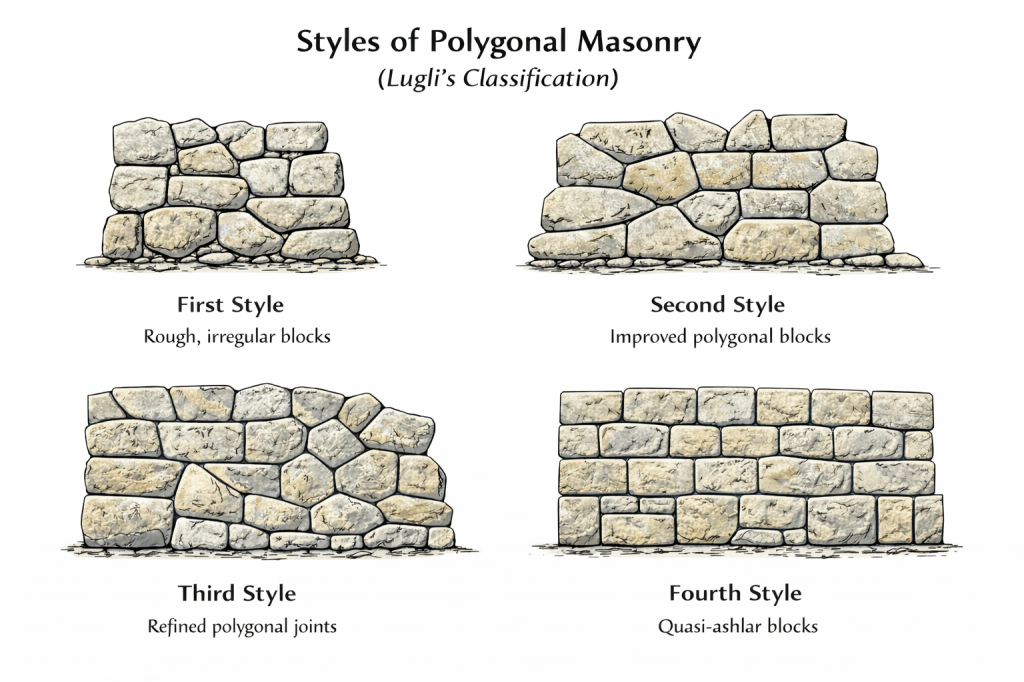
For the purposes of this site, we will use the most widely accepted classification system from the Mediterranean – Giuseppe Lugli’s four polygonal styles from his book La tecnica edilizia romana (1957). This particular typology is centered on Italic polygonal walls and specifically the Roman era. While it differs slightly from descriptions based on Greek and Anatolian polygonal constructions, the Roman influence eventually encompassed all of the Mediterranean.
According to Lugli, polygonal walls can be classified into four categories based on their technological and morphological characteristics.
Type I – Rough polygonal masonry – large, irregular blocks, minimal dressing, gaps filled with smaller stones
Type II – More regular polygonal masonry – better-shaped blocks, improved jointing, still visibly irregular
Type III – Fine polygonal masonry – precisely cut stones with tight joints, highly refined fitting
Type IV – Quasi-isodomic polygonal masonry – transitional form approaching ashlar, courses begin to appear
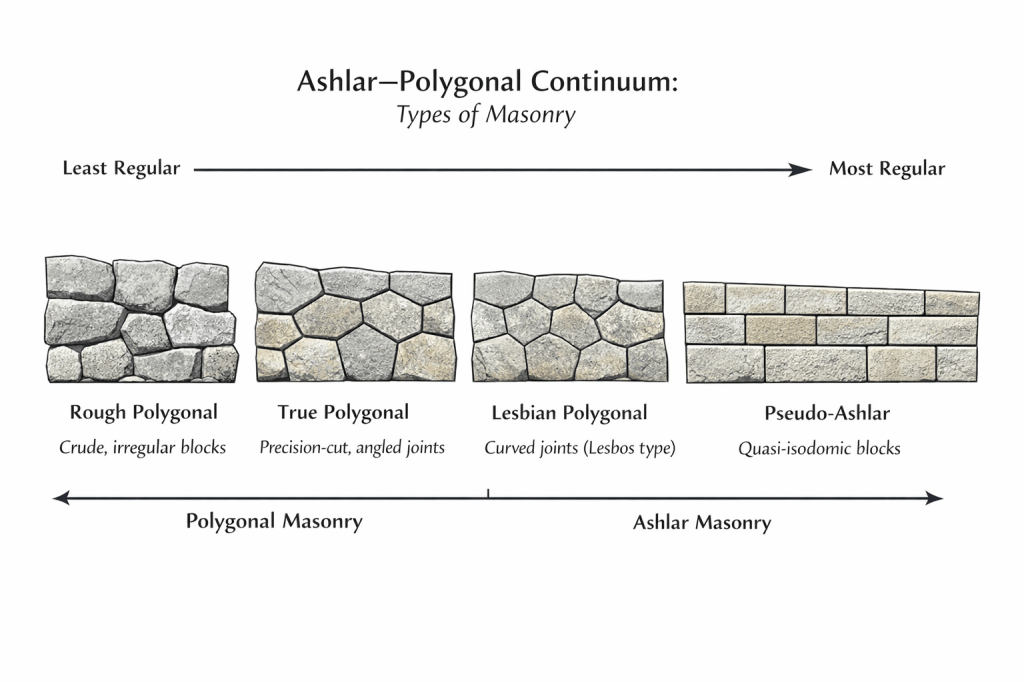
Another commonly used classification method (although one that is not standardized in the literature) is found with Greek and Anatolian polygonal walls. Archaeological records from sites found throughout this particular region tend to use the following terminology when classifying polygonal walls.
 Minutiae